Sunday, June 26, 2011

Trash Bag Bunch

Something shorter this week - the Trash Bag Bunch.


These toys carried on the "monsters and mutants" themes of toys in the '90s, as well as having a slightly ecological message like Captain Planet and The Planeteers. They came in two varieties - Disposors and Trashors. The Trashors were the bad guys, mutant freaks that spread pollution and slime all over the planet. The Disposors were the good guys, who took care of the environment the only way they knew how - with guns!
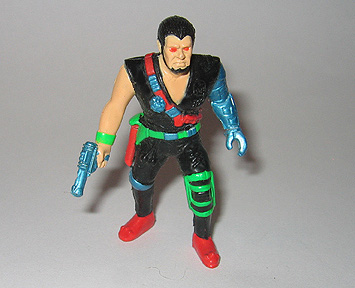
Sgt. Wastenot doesn't mess around.

It was often hard to tell who was a good guy and who was bad. Both sides have killer robots, and almost all of the good guys are cyborgs with glowing red eyes. They also all wear black and carry guns, which is usually a sign of villainy. This is because, as you can learn here, the original series was just going to be called Robots, Aliens, and Monsters (at least by Galoob).
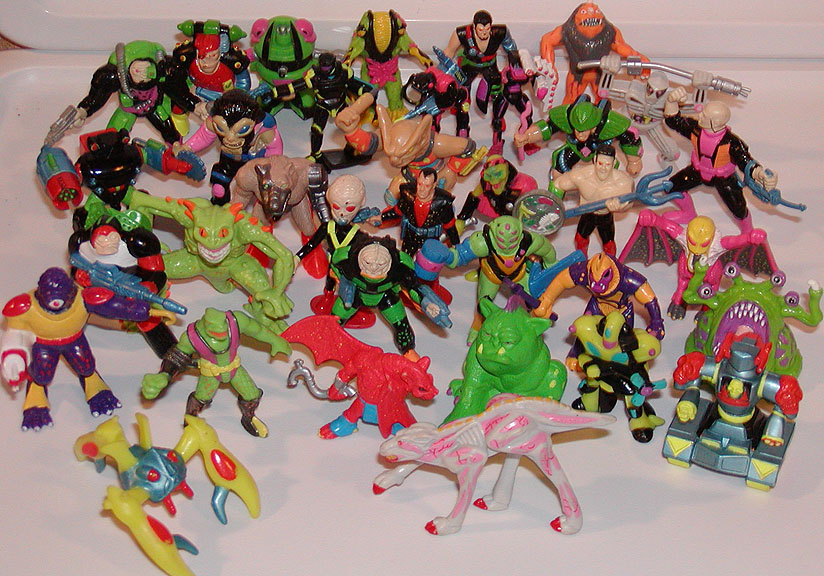
The complete set

The toys weren't very fun to play with. Much like Monster In My Pocket, they didn't have joints, although they did have good neon colors and detail. The fun was in the packaging. They came in opaque "garbage bags" that would dissolve when you dropped them into water. Not only would the bag dissolve, but the water would fizz because of a tablet that was included in the bag. Only then would you know which ones you ended up with. This element of mystery made buying the toys exciting.
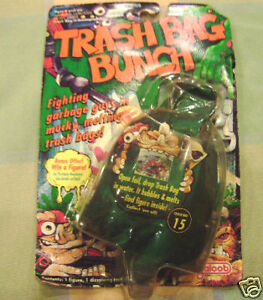
A Trash Bag Bunch package

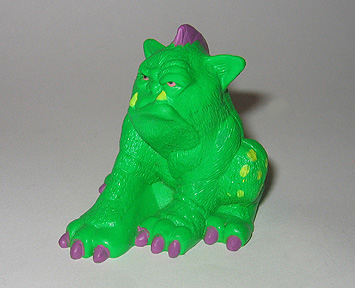
My brother and I had about half of the collection between us. I can't remember playing with them, but I do remember which ones were my favorites. Their names were Garbeast and Muckoid, and they were both villains. I especially like the extra row of teeth on Muckoid.
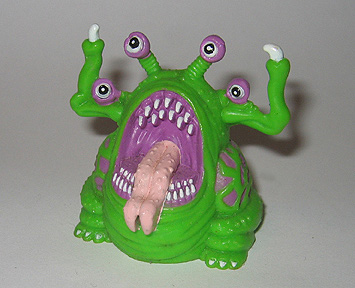
Muckoid

So that's that, another of the coolest toy series of the '90s. If you liked reading about the history of the series, I'd suggest looking at the sketches for later toys - some of them were really weird.

Sunday, June 19, 2011

Summer Reading - Calvin and Hobbes

Today's post is about Calvin & Hobbes, which I consider to be a pillar of my experience of the '90s. That's why it's so late - I had to take extra time to summon up the words to do it justice. And I probably still can't do it, but I can't wait forever, either, so here goes.

Perhaps no artistic work has had as great an impact on my mind and worldview as Calvin and Hobbes, Bill Watterson's magnificent comic strip about an imaginative six-year-old boy and his pet tiger. As soon as school was out and water fight season began, it was once again time to go to the library and check out every Calvin and Hobbes anthology I could get my hands on.

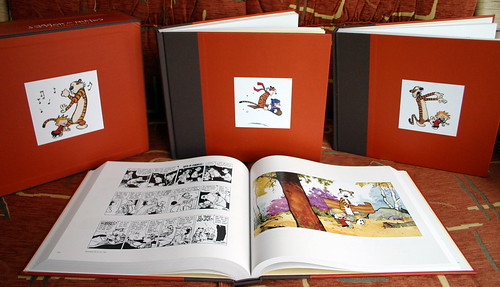
And now I have it all.

The basic plot of Calvin and Hobbes covers the daily life of Calvin and his imaginary tiger, Hobbes, who only he sees as a real tiger and not a stuffed animal. Calvin has a very active imagination that often lands him in trouble, whether he is daydreaming instead of paying attention or turning it towards mischief. Hobbes is a foil to Calvin, often advising him against his more foolish adventures, providing a counterpoint or another perspective to Calvin's philosophical musings, and frequently fighting with him. Both characters are extremely well-developed and have many different sides.

The strip started in 1985 and ran until 1995. I actually never read it in the comic section of the newspapers, and I don't know how I even became aware of it. But for the ten years it ran, it was consistently excellent. It features wonderful, intelligent writing that is usually hilarious, but at other times can be profound and have a lot of emotional depth, such as when Calvin finds a dead bird and muses on the fragility of life, or when he loses Hobbes and can't find him. The deep, cerebral writing is complimented by the incredible illustration. Calvin's world is seldom limited to a few talking heads - it's full of surreal landscapes and styles. It's very detailed, and there are many full page color strips.

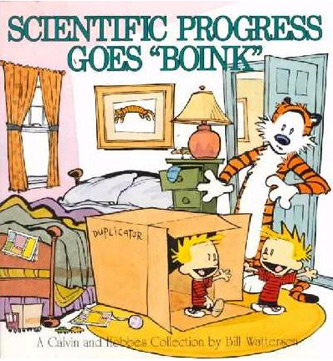
I love the duplicator story.

 These styles frequently surface when Calvin imagines he is one of his alter-egos. As the intrepid explorer Spaceman Spiff, he is often captured by aliens when he crash lands on rocky desert planets, to be tortured with homework, math problems, or bath time. Then there's Tracer Bullet, a hard-boiled detective who only trusts his .38 special and his hip flask. His world is inspired by the shadowed back alleys of film noir. But Calvin can just as easily imagine himself as a dinosaur (or my favorite, a tyrannosaurus in an F-14), an ant, a living skeleton, or a two-dimensional boy as flat as a sheet of paper. Possibly the boldest, most unique strip features Calvin imagining himself as a malevolent god of the underworld.

I credit Calvin and Hobbes with introducing me to philosophy, for better or worse. This has been the most significant impact the strip had on me - after all, I went on to major in it. Calvin and Hobbes talk about such philosophically rich topics as ethics, meaning and purpose, mortality, humanity's place in nature, and whether or not a god exists. It was Calvin and Hobbes that first showed me that these were open questions worth pondering.


The thing about Calvin and Hobbes that sets it above and beyond all other comic strips is that there is not a single panel or storyline where Bill Watterson is phoning it in. It remains consistently wonderful for all ten glorious years. There are new ideas in every panel. It never becomes stale or repetitious, and unlike many long-running series, the quality never deteriorates. It's the project of one devoted artist, given the freedom to create, and pour out his good soul on the page. Humanity is richer for it.

Sunday, June 5, 2011

Attack Pack

This week, I'll be reminiscing about a series of toys that I enjoyed quite a bit in my childhood - Attack Pack.


These strange toys combined three things I loved - vicious animals, transforming, and monster trucks. Created by Mattel, the corporation also responsible for Hot Wheels, it's pretty clear where Attack Pack came from. Someone on a marketing team said "Hey, the kids really like this Beast Wars thing, right? So why don't we make them into cars?" And they did, and it was awesome.

There was no TV show that Attack Pack was inspired by, but the packaging did come with a convoluted and confusing story with environmentalist themes like Captain Planet. The toys were also divided into good guys and bad guys as in Beast Wars and Transformers before it. It's a time-tested formula.

The Attack Pack toys came in many different models, some of which were sold at McDonald's. The first series were all based on monster trucks and rather normal animals, but later the series branched out to include flying vehicles like planes and dinosaurs. There was also a series of space-themed vehicles like rockets and UFO's, which were merged with weirder, grosser animals like leeches and maggots.

The toys typically could roll on their wheels, and they had a lever in the back you could push down on to make them rear up and transform into their animal mode - their teeth, claws, or wings would come out. Later, Mattel released the "growlers" series that made a roaring sound when you pushed the lever, but these actually weren't as cool as the original series - there was much less diversity in the types of vehicles and animals. They were all either cats or bears, all the models of the same species were in the same mold with a different paint job.


Looking at the pictures of these toys makes me remember how cool they were, and which ones I had and which ones either my brother or my friends had. But the happiest memory I have of Attack Pack toys is of my brother and I getting some really cool ones for Easter. These were in the "Big Ones" series released in 1993. I got Blowtorch, which was styled after what appears to be a bulldog mixed with a fire truck, and Slime-Inator - the ultra-cool huge Attack Pack monster designed after a hornet mixed with a cement truck. He had an ability none of the others did - he could dump a green goo all over them. Unfortunately, the goo was no good after the first use - I played with it outside and got dirt in it. Ain't that always the way?

My brother got Big Bones, a truck with a cage on the back that could hold a smaller Attack Pack vehicle prisoner. The really cool thing about the "Big Ones" series (as opposed to the "Biggest Ones" series that Slime-Inator was from) was that when you pushed down the lever, not only did they rear up and transform to reveal jaws, but their front wheels contained claws. This differentiated them from the smaller ones.


I only have foggy memories of playing with these toys, but I know it must have taken some imagination. I remember rolling them through the grass in my backyard and pretending they were stalking through the jungle. I remember the feel of these toys in my hand. They couldn't move like Hot Wheels, and they had no fancy tracks they could speed along and fly through loops, but they remind me of how I always liked the unusual and unrealistic monster-shaped Hot Wheels cars rather than regular sports cars and F1 racers. These toys tapped into the part of my personality that made me like horror movies better than action movies, anti-heroes better than traditional heroes, and death metal better than hair metal. They are proof that design by committee can actually work. And so it is with great fondness that I thank the soulless corporation Mattel for enriching my childhood.

Sunday, May 29, 2011

Summer Reading - Goosebumps

The rising temperatures and siren songs of ice cream truck patrols are signs that summer is here once again, and for me that means memories largely of reading books inside, ironically. Every summer, my parents had me join the library's reading program, which set goals for summer reading that I could keep track of with a card that was stamped whenever I completed a book. Prizes could be won - probably things like Yikes! pencils and bookmarks, because I don't remember them very well. But I do remember where the bulk of my reading came from during the summer - Goosebumps. 

"Why do we keep feeding them Monster Blood?"

Goosebumps was a kids horror series written by Ohio native R.L. Stine. This guy was a machine - there were 64 books in the original series alone. Goosebumps may have played a large role in my enjoyment of horror, because I read and re-read these books until the covers were cracked and frayed.

As far as horror went, Goosebumps was actually the least scary of the horror franchises read. It was written for children, but the books still contained events such as human sacrifice, cannibalism, alternate realities, and possessed dummies. Ghosts of Fear Street was a series R.L. Stine wrote for slightly older children, and Fear Street was written for teenagers. But what gave me nightmares was the Scary Stories To Tell In The Dark series - not for the stories, which were rather silly, but for the horrifying ink drawings by Stephen Gammell. But that's a subject for another post.

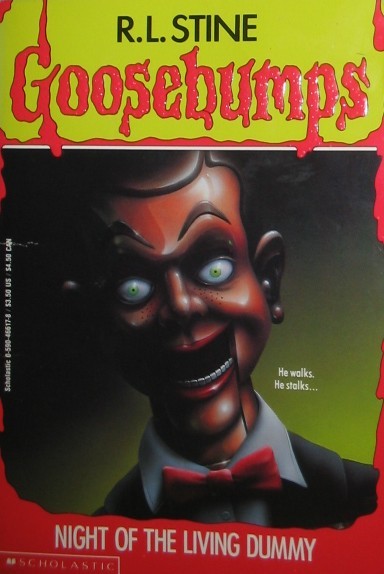
This was probably the scariest book.

What brings back the nostalgia for Goosebumps more than anything is the artwork on the covers. I sold my collection in a garage sale long ago and can't remember the stories very well, but the front covers are instantly familiar.

Looking over the plot summaries on Wikipedia, though, some of them seem quite interesting. There's an evil house that is turning the town into the undead, a camera that predicts the death of whoever it photographs, a mirror that leads to a parallel universe, and an insane piano teacher who wants to cut off his student's hands.

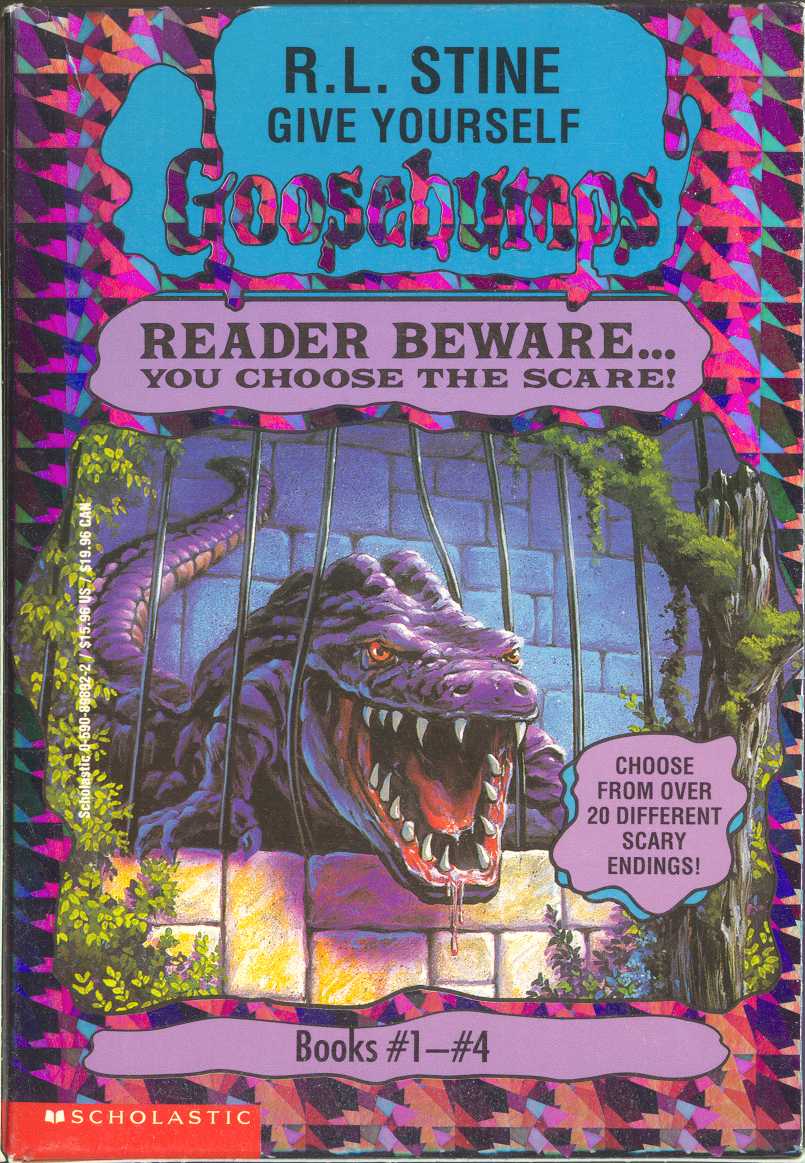
In addition to the three series Goosebumps, Fear Street, and Ghosts of Fear Street, R.L. Stine also wrote the "Give Yourself Goosebumps" series. These were choose-your-own-adventure books, in which you flipped to different versions of the story depending on what choices you make. These were a lot of fun to read, and finding the ending where the characters make it out alive was pretty tricky.

I could spend all day with one of these books.


There was also a Goosebumps TV show that ran during the late '90s, which I also enjoyed. But one of the coolest things R.L. Stine did was to write a horror story about The Beast roller coaster at King's Island being haunted. I read this book right around the time I first rode The Beast, and when it became my favorite roller coaster ever. It still is.

Apparently it's haunted by...um, Poseidon?

I can remember the first time I rode The Beast, at night, just before the park closed. The Beast has a long track that goes deep into the woods, and that's part of the thrill of it - there are branches all around you as you whip along the track at 60 miles per hour. These branches, the low tunnel coming off the first hill, and chaotically-placed wooden beams in the "spiral of doom" at the end of the ride, all give the illusion that the ride could decapitate you. The ride is genuinely frightening. And whether finding it on roller coasters or in R.L. Stine's books, I was always looking for a good scare.

Sunday, May 22, 2011

Pogs

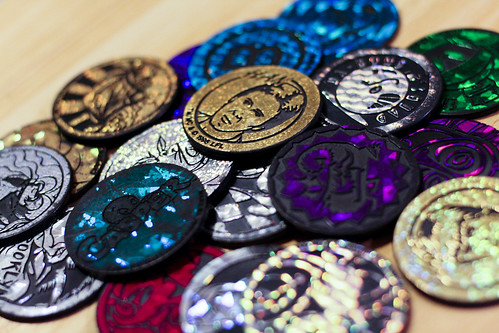
Pogs was (were?) a flash-in-the-pan craze on my elementary school playground that inexplicably took the world by storm in 1994. Originally played in Hawaii with milk caps (in 1927), the game involves stacking up cardboard discs with pictures on them and hitting them with a plastic disc called a "slammer." All the caps that landed face up were added to the player's score, either to be kept or to keep track of the winner of the game. Usually, the people on my playground played for keeps.

Sonic The Hedgehog pogs

These little tokens were mostly collectibles, and they could feature pictures of anything - Taz, The Tick, Animaniacs, or Cadbury Creme Eggs. Anything we liked had a pog version. Aside from collecting them, there was nothing else you could do with them except play the game, which was not very fun. There were a lot of arguments about how to hit the stack because the rules were poorly defined, and most of the time, the stack was simply knocked over with nothing flipping. Often the disputes over the rules led to fights.

I may have only played Pogs for a little while, but I can still remember my favorite slammer. I liked the slammers better than the pogs, because they were shiny and had simpler, bolder designs. I had a purple slammer that depicted an atomic bomb on it. It came with the first pack of pogs I got.

Slammers 

The teachers and the aides - the playground police -  hated it, and it was ultimately banned in many schools - possibly in mine. Part of the reason it could have been banned was that it was a form of gambling.

Another pog-related memory I have is of receiving some pogs for Easter one year. Instead of a plastic slammer, they came with a spiky metal slammer - which was much heavier and therefore able to flip more pogs. My memory is hazy, but I think the other kids viewed this as cheating and didn't let me play using that one. As far as I know now, that was a legal slammer.

Around that time, the whole Pog thing had just about run its course, as every kid in America (and around the world) realized that Pogs were boring. Like Beanie Babies, Tickle Me Elmo, and Furby, the mindless fad vanished.

Sunday, May 15, 2011

Alternative Rock

A number of factors combined to introduce me to alternative rock in the '90s. I have an older sister who was in the target audience (Generation X), who shared such bands with me as Nine Inch Nails, Bush, Garbage, Green Day, and Stone Temple Pilots. My parents also like this music, especially my dad. And then there was 103.9 The Edge, a station that for at least three glorious years before they became The X, played almost nothing but the best in '90s rock.

I was a fan.

103.9 became The Edge in 1995, and that's probably around the same time my musical awareness really took off. I was 10 years old and in 5th grade. I have a lot of jumbled memories of when I received CDs by my favorite artists (although it was mostly Christmas) and quite a few photographs. Here's one now:

Wearing my Insomniac t-shirt at Camp Kern, 1995.

Being only 10 in 1995, Kurt Cobain's suicide didn't have as big an impact on me as it would have had on a slightly older crowd - in fact, I'm not even sure I knew about it until years later. I liked Nirvana and got their CDs from the library all the time, but they weren't my favorite band. During the '90s, my favorite band was The Smashing Pumpkins. My parents took me to a concert when I was 11 years old, a story I'll go into later.

Getting NIN's Broken for my birthday - probably '97

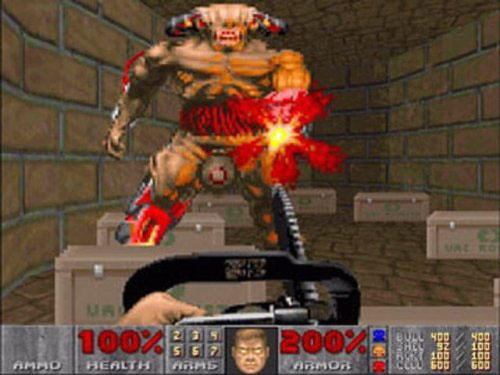
Another favorite band of mine was Nine Inch Nails. Although they played on The Edge, they were not alternative rock. The songs off the album Pretty Hate Machine that played were "Head Like A Hole" and "Down In It." But that album was much less abrasive than Broken and The Downward Spiral, which only spawned one hit single, "Closer." It's funny that I think of myself as having been sheltered, considering that my parents didn't forbid me to listen to any music. The Downward Spiral is very explicit, featuring themes of sex, murder, nihilism, rape, and suicide. I borrowed it from the library regularly from the age of 12, listening to it while blowing monsters away in Doom II, another much maligned bad influence.

IDDQD

The darkness and aggression of Nine Inch Nails was contrasted by the upbeat and energetic pop punk tunes of Green Day, a band that always puts me in a good mood. The first album I got by them was Dookie, and it's still one of my favorites. I also had Insomniac.I frequently borrowed 1,039/Smoothed Out Slappy Hours from the library, and it has some of my favorite songs on it, too. I was dimly aware, having a friend who was into older punk music, that Green Day were not considered "authentic punk." This is just hilarious to me now - they weren't cool enough to join the outsider clique.


And speaking of bands that were considered "posers," there's Bush. They were another of my favorite bands, although telling people that I liked them often brought out some resentment because "they ripped off Nirvana." Listening to them now, they sound no more like Nirvana than Soundgarden, Stone Temple Pilots, Alice In Chains, or other bands in the same genre. Bush sounds more polished, has better guitar playing (and solos), and better singing. I like Sixteen Stone better than any of Nirvana's albums. I also had Razorblade Suitcase.

Me at the bat exhibit, Cincinnati Zoo

So there you have it, a shallow look at my top five favorite bands of the '90s as I would have listed them growing up, all featured on my favorite radio station, 103.9 The Edge. Around 1998, the Edge turned into The X, and alternative rock was gradually pushed out by ska and nu-rock, which ultimately led to my turning off the radio and seeking out new music on my own. But of course I always kept my favorite music with me.

Sunday, May 8, 2011

Pizza Lunchables

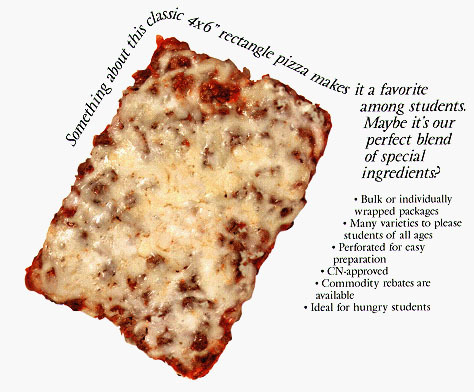
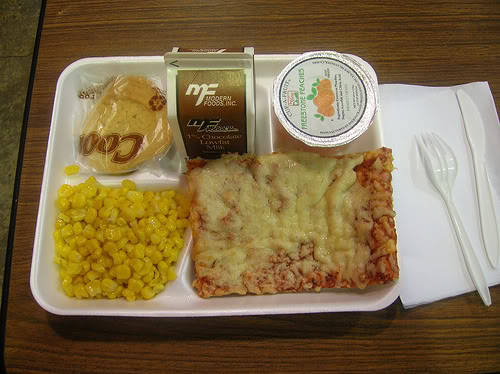
Unlike many who went through the public school system, I have fond memories of eating cafeteria pizza. This pizza was served in a rectangular slab with rubbery mozzarella cheese on it, usually at about room temperature. The crust was soft enough to roll up. It was the best pizza in the world.

They sound baffled as to why kids like it.

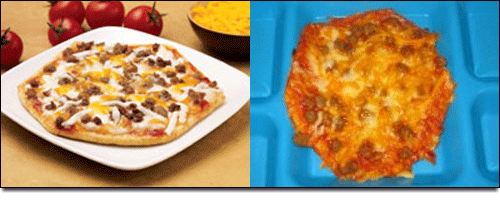
Pizza was a treat, served either once a week or once every two weeks, I'm not sure which. But the big prize was Mexican pizza. That was my favorite. It had spicy sausage, bright orange cheese of unknown origin, and a spicy pizza sauce. It was shaped like a hexagon, which to my young eyes made it look like there was more of it. My best lunch was a slice of this, a small bag of Doritos or Cheetos, and a cardboard carton of chocolate milk.

A rough estimation of a hexagonal slice of Mexican Pizza

But pizza could not be served every day, and on those days, I didn’t have to risk meat loaf. On those days, there were Pizza Lunchables. Oscar Meyer started the Lunchables brand in the late '80s, but Pizza Lunchables were not released until sometime in the '90s. While these were not as nice as the school pizza, they were still a yummy food item.

The Lunchables meal came in a plastic tub, with a compartment for each part of it. The pizza crusts and sauce were in the main compartment, which also held a candy item and a Capri Sun. Lunchables offers pepperoni pizza and cheese. Pepperoni only came with mozzarella, but cheese pizza comes with mozzarella and American or cheddar (something orange, at least). Since I've been a vegetarian since I was 10 years old, I usually had the cheese pizza Lunchables.

The meal is eaten by hand. You open the packet of paste and spread it on the pizza crust, then put as much or as little cheese on it as you want. Rationing is important; I usually ended up putting most of my paste on the first pizza, and the other two would not be as good.

In order to properly remember Lunchables, I had to experience it again myself, and so I bought an extra cheesy Pizza Lunchable from the store. It was almost as good as I remember it being, but I remember the pizzas being larger and having more sauce. More likely it’s just that I’m bigger.

While eating this pizza, I noticed that there was not enough sauce to go around, and the cheese lasted much longer than the sauce. I had about half a compartment of each left over after all my crusts were gone. The cheese does not taste nearly as good by itself as it does on the pizza.

I was also pleasantly surprised to find an Airhead blue raspberry candy in the bottom of the pizza compartment for dessert, and a Capri Sun under the tub. The Capri Sun was fruit punch, and it was delicious. I also managed to puncture it with no problem and no loss of juice, which was always an accomplishment. Pizza Lunchables are still widely available, and they taste just as good as they were in school.