Sunday, July 31, 2011

Summer With Nick

Almost every summer when me and my little brother were kids, around this time of year - about the middle of summer - we would go visit my grandma and grandpa in Indiana for about a week or two, sometimes staying with them while our parents went on trips (they went to Arizona one year and generally out West another - Oregon and California). These weeks would be spent fishing with my grandpa and cousin Brandon, climbing their pine trees, shooting at Diet Rite cans with BB guns, watching hummingbirds at the feeders, and visiting the A & W to get cheese fries and root beer floats. It was always a fun time. But we spent a lot of the days down in the basement, watching Nickelodeon on TV.

My brother and I were deprived as kids (insert sarcasm tag here). We never had cable growing up, except for one brief summer in high school where we had Direct TV. We still don't have cable in my house, and don't really feel a need for it. Now that the stations have switched to digital, we have five channels of PBS, where I can watch all the Nova, Nature, Frontline, and Ohio's government at work that I need to be content. During that time we had cable, it sucked so many hours away from each day. But I'm not posting to bash cable and admonish people to value simplicity; I'm actually remembering how great it was for those few weeks every year to veg out in front of the TV from around two in the afternoon to midnight, and I'm starting with Nick. The next post will be about Cartoon Network.

Nickelodeon had some awesome programming in the '90s, but the very best show they ran was The Adventures of Pete & Pete. This is a story about two brothers, both named Pete, and their adventures, if you will, in a weird suburban neighborhood. The show is very funny, as I can confirm from having watched season one again recently.

Big Pete, the older brother, is the overly-dramatic and philosophical narrator, and most of the episodes are told from his perspective. Little Pete is his weird and obnoxious younger brother. He has a tattoo of a lady named Petunia, and calls people "blowholes."

Each episode is well-written and has a different feel to it, and one of the things I found most interesting on watching it again was that the episodes narrated by Little Pete have different themes and express a very different worldview - a more cynical, practical, self-interested worldview. The show is so well-written that I'm certain most of the humor went over my head when I was ten years old, and is much funnier now. And who can forget the catchy and memorable theme song?


Perhaps my favorite show when I was a kid was All That, a kids' comedy-sketch show. As a testament to how limited its appeal is, though, I can't remember much of anything from it, except the in-your-face attitude that typified TV kids in the '90s. I was certainly never like that, but I thought the show was very funny. Here's a sketch the illustrates the contrast between the now-cringe-inducing kids' humor to the brilliance of Chris Farley's delivery. Kenan Thompson is an SNL, now, and he is doing basically the same act.


The whole joke is just Chris Farley squirting ketchup everywhere, but he makes it hilarious even though he's just doing the same Matt Foley voice he did on Saturday Night Live. Notice how he also works in his "Bulls fan" sketch by faking a heart attack.

Another favorite was Aaahh!! Real Monsters! This was a show about three monsters attending a school to learn how to scare people - basically the same plot as Monsters, Inc.. It was right up my alley, because I like anything with dark themes or that has main characters who would typically be considered villains or anti-heroes.
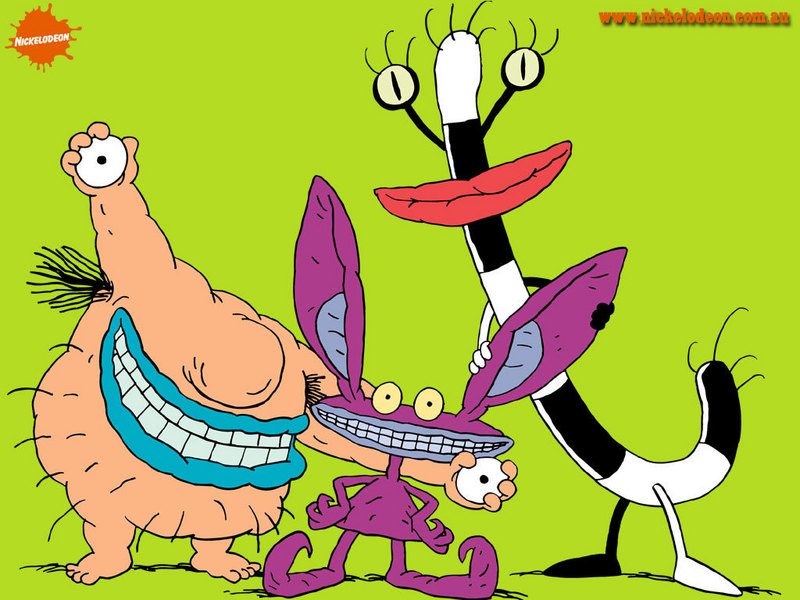
Crumb, Ickis, and Oblina

Another Klasky Csupo cartoon that I enjoyed was Rugrats, a cartoon about a group of talking babies. Chuckie was my favorite. It's a lot like Bobby's World, a show I liked better, and Muppet Babies, a show I didn't like, but which Nickelodeon aired during the day. Most of the humor comes from the way the babies talk, similar to Bobby's World, where the humor is based on Bobby's misunderstandings of what older people say. Rugrats has too many gross diaper jokes.

Two of the shows that stood out from the afternoon lineup were :Legends of The Hidden Temple and Are You Afraid of the Dark? Legends was a game show where kids had to run an obstacle course themed as an Indiana Jones-style ancient temple. Teams competed against each other to find keys and artifacts that would allow them to move onto the next round. It's especially interesting because there are six teams rather than the standard four or two. Best of all was the giant talking stone head Olmec (who sounds nothing like what a giant stone head should sound like). I never watched GUTS, Double Dare, or What Would You Do?, but I did watch this every chance I got.

Are You Afraid Of The Dark? was a horror show. It was like the Goosebumps TV series. It had good atmosphere (just check out the opening) and some pretty scary stories. The most memorable and disturbing episode is the one where some kind of disease is causing everyone to die of laughter. It was called "The Tale of The Ghastly Grinner, and is a perfect example of nightmare fuel.


This is still pretty creepy.

I've left out a lot here, most notably Ren & Stimpy (which I didn't like), Rocko's Modern Life (which I only watched once or twice, but which sounds like a funny show), and Doug (which was okay). But that's a pretty good summary of what I liked about Nickelodeon.

Next week, Cartoon Network. See ya then.

Sunday, July 24, 2011

Captain Planet and The Planeteers

When I was five or six years old, I loved the show Captain Planet and The Planeteers. This is probably one of the most well-known '90s pop culture icons. The show displays many of the things that made '90s shows successful, and many of the values they tried to teach us in the '90s. It's also got a very catchy theme song. This video contains the intro to the show and the theme song at the end.


Captain Planet's mission is "to take pollution down to zero." He is an Earth elemental, a mullet-wearing mythological being summoned by the power rings of the team of five Planeteers, who come from all over the world. He was appointed by Gaia, the spirit of Earth, to protect the planet from the pollution of a team of polluting evildoers that are each representative of a problem in society, mostly related to environmental issues.

The villains are a colorful crew. There are poachers, unethical and greedy business people, evil scientists. There's Hoggish Greedly, Looten Plunder, Sly Sludge and his sidekick Ooze, Duke Nukem (not the videogame character), and Dr. Blight, the mad scientist. I used to think they were exaggerated. For instance, I didn't get why Sly Sludge was always dumping stuff into the ocean. Now I know that corporations do stuff like that all the time. Here's a clip that shows Sly Sludge dumping waste into the ocean.


The Planeteers represent some of the values and themes that were frequently in '90s TV shows. They are a team, and that teaches the value of teamwork and cooperation. They are racially diverse, which teaches acceptance. They come from all over the world, which represents the message that protecting the environment is a global issue, and all nations need to do their part. Captain Planet tells them "the power is yours," meaning everyone has the power to protect the environment.

It's also similar to the Power Rangers, as you could have a favorite Planeteer. When I was a kid, I would have most wanted the power of fire, so he was my favorite. However, judging from his personality, he was the most obnoxious jerk on the team.

I mentioned that Captain Planet has a mullet haircut. So did I.

No comment.

Sunday, July 17, 2011

PBS After School

More often than not, instead of watching cartoons after school, my brother and I would watch educational PBS shows. The station had a great lineup in the 1990's.


The afternoon would start off with Wishbone, a show about a highly intelligent and literate Jack Russel Terrier who has many daydreams about classic literature. He could talk and be heard by humans in his imagination, but not in real life. He would imagine himself as these characters from stories, and it was educational because it explained the plot of the stories. It had a catchy, pun-heavy theme song, and the dog was cute in the hundreds of little costumes they dressed him in..


The next show on was Ghostwriter, a show about a group of kids that solve mysteries with the help of a ghost that can write. The kids can read his messages, but no one else can. Although it is all about a ghost that reads, it seems like the show is more designed to teach critical thinking and problem solving.


Bill Nye The Science Guy was the third show on after school. This was an awesome show that taught science and made it fun. We were lucky when they showed Bill Nye in school. The show had a lot of wacky humor to make the concepts understandable to kids, and each show ended with a music video that was a parody of a song with scientific lyrics. Enjoy this clip from the show:


Finally, there was Where In The World Is Carmen Sandiego?, a geography game show about catching the criminal Carmen Sandiego and her many henchmen. The show was exciting because of the detective agency theme, but also because of the band Rockapella, who created a very catchy theme song.


That wrapped up the afternoon kids programming on PBS. There was a show about math, but I never watched it. It was never my strong subject, and it was always dinnertime by the time that show came on.

I've been watching PBS since I was four or five, starting with Sesame Street, Reading Rainbow and Mr. Rogers' Neighborhood. I still watch History Detectives, Nova, Frontline, Nature, and Antiques Roadshow all the time. It makes me a little grateful that we never had cable when I was a kid, or I might have overlooked it.

Friday, July 8, 2011

Gargoyles

Gargoyles was one of the coolest kids' shows of the '90s. It was a show about living gargoyles, creatures that would turn to stone by day and come to life at night. Rather than describing the story, though, I can simply show it with the opening theme.


The main characters of the show were a clan of gargoyles who hail from medieval Scotland. They were turned to stone for a thousand years by a wicked sorcerer. Now they've come back to life in modern-day New York City, and they act somewhat like superheroes, defending the city from the machinations of Xanatos, an evil tycoon trying to take it over. He is somewhat like an evil version of Batman, able to afford all kinds of neat gadgets.

The main clan of gargoyles are all interesting characters with unique personalities, although the show features hundreds of side characters as well. Goliath is the leader; he's the strongest, but he has a strict moral code and can sometimes be preachy. Hudson is the elder of the clan, and is mostly an adviser. Lexington is the smallest gargoyle, intelligent and fascinated by technology. Brooklyn is the second-in-command, sarcastic and sort of a wiseguy. Broadway is friendly, naive, and enjoys old movies. Finally, Bronx is the clan's guard dog. He behaves like a dog rather than having anthropomorphic qualities. They help the human police officer Elisa Maza solve crimes, usually committed by Xanatos and his henchmen, The Pack.

From left: Bronx, Hudson, Goliath, Lexington, Brooklyn, Broadway

Just as varied as the gargoyles are the wide cast of villains in the show. Xanatos, the main villain, uses a gang of mercenaries called The Pack that in public are celebrities (similar to pro-wrestlers), but in private hunt the gargoyles. 

From left: Hyena, Jackal, Fox, Wolf, Dingo

Another arch villain is Demona, a gargoyle poisoned by hatred for the human species stemming from what she perceives as a betrayal. She wants to kill all humans, and will destroy anyone who gets in her way. She used to be Goliath's betrothed, but she now views him as weak and foolish for protecting the humans. In one episode, she faces another villain known as the Hunter, who has the opposite agenda - he wants to destroy all the gargoyles.

Demona, appearing slightly older than usual

The show had the same spirit of a lot of media and toys I admired as a child, of monsters and mutants as the heroes. It had some dark themes running through it, and intelligent writing that was heavily inspired by Shakespeare. The voice acting was also top notch for most of the characters, particularly Keith David, who plays Goliath

I had Gargoyles sneakers when I was a kid. I remember going to Burger King several times to get the toys. I had seen Disney's Fantasia, and I think that may have been part of the reason I loved this show. The chernabog, the demon portrayed in "A Night On Bald Mountain," has to curl up and seems to become part of the mountain at the break of dawn.Gargoyles are like him, but they're good guys.

Chernabog shrinking away from the disgusting sunlight.

Sunday, June 26, 2011

Trash Bag Bunch

Something shorter this week - the Trash Bag Bunch.


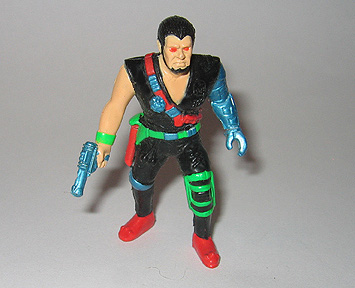
These toys carried on the "monsters and mutants" themes of toys in the '90s, as well as having a slightly ecological message like Captain Planet and The Planeteers. They came in two varieties - Disposors and Trashors. The Trashors were the bad guys, mutant freaks that spread pollution and slime all over the planet. The Disposors were the good guys, who took care of the environment the only way they knew how - with guns!

Sgt. Wastenot doesn't mess around.

It was often hard to tell who was a good guy and who was bad. Both sides have killer robots, and almost all of the good guys are cyborgs with glowing red eyes. They also all wear black and carry guns, which is usually a sign of villainy. This is because, as you can learn here, the original series was just going to be called Robots, Aliens, and Monsters (at least by Galoob).

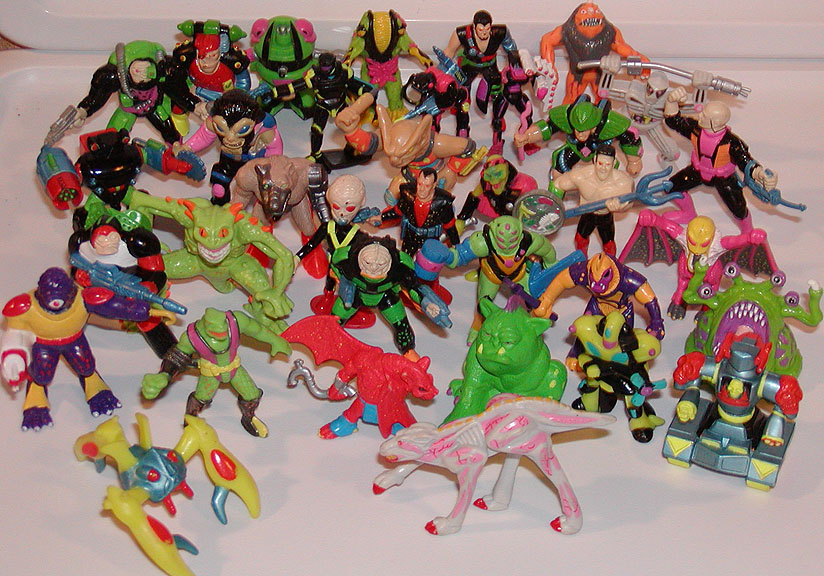
The complete set

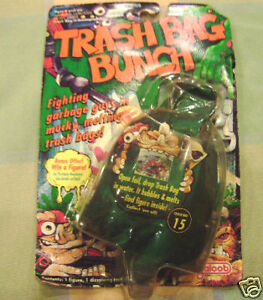
The toys weren't very fun to play with. Much like Monster In My Pocket, they didn't have joints, although they did have good neon colors and detail. The fun was in the packaging. They came in opaque "garbage bags" that would dissolve when you dropped them into water. Not only would the bag dissolve, but the water would fizz because of a tablet that was included in the bag. Only then would you know which ones you ended up with. This element of mystery made buying the toys exciting.

A Trash Bag Bunch package

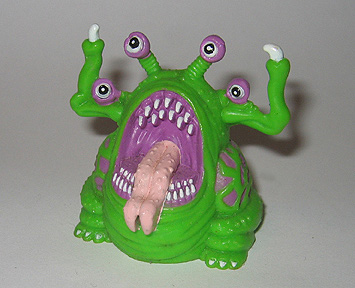
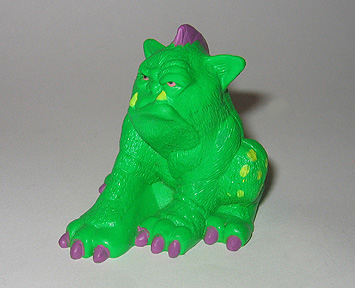
My brother and I had about half of the collection between us. I can't remember playing with them, but I do remember which ones were my favorites. Their names were Garbeast and Muckoid, and they were both villains. I especially like the extra row of teeth on Muckoid.

Muckoid

So that's that, another of the coolest toy series of the '90s. If you liked reading about the history of the series, I'd suggest looking at the sketches for later toys - some of them were really weird.

Sunday, June 19, 2011

Summer Reading - Calvin and Hobbes

Today's post is about Calvin & Hobbes, which I consider to be a pillar of my experience of the '90s. That's why it's so late - I had to take extra time to summon up the words to do it justice. And I probably still can't do it, but I can't wait forever, either, so here goes.

Perhaps no artistic work has had as great an impact on my mind and worldview as Calvin and Hobbes, Bill Watterson's magnificent comic strip about an imaginative six-year-old boy and his pet tiger. As soon as school was out and water fight season began, it was once again time to go to the library and check out every Calvin and Hobbes anthology I could get my hands on.

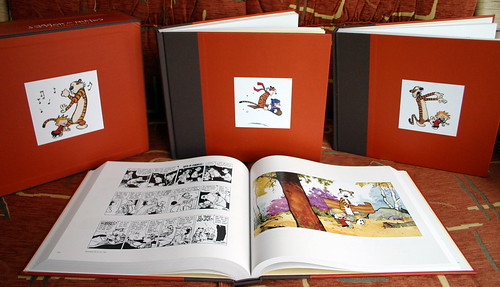
And now I have it all.

The basic plot of Calvin and Hobbes covers the daily life of Calvin and his imaginary tiger, Hobbes, who only he sees as a real tiger and not a stuffed animal. Calvin has a very active imagination that often lands him in trouble, whether he is daydreaming instead of paying attention or turning it towards mischief. Hobbes is a foil to Calvin, often advising him against his more foolish adventures, providing a counterpoint or another perspective to Calvin's philosophical musings, and frequently fighting with him. Both characters are extremely well-developed and have many different sides.

The strip started in 1985 and ran until 1995. I actually never read it in the comic section of the newspapers, and I don't know how I even became aware of it. But for the ten years it ran, it was consistently excellent. It features wonderful, intelligent writing that is usually hilarious, but at other times can be profound and have a lot of emotional depth, such as when Calvin finds a dead bird and muses on the fragility of life, or when he loses Hobbes and can't find him. The deep, cerebral writing is complimented by the incredible illustration. Calvin's world is seldom limited to a few talking heads - it's full of surreal landscapes and styles. It's very detailed, and there are many full page color strips.

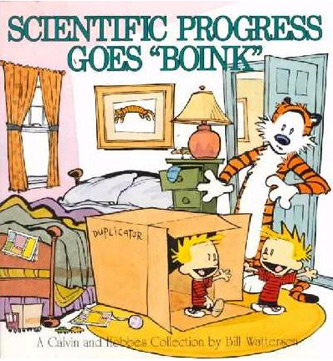
I love the duplicator story.

 These styles frequently surface when Calvin imagines he is one of his alter-egos. As the intrepid explorer Spaceman Spiff, he is often captured by aliens when he crash lands on rocky desert planets, to be tortured with homework, math problems, or bath time. Then there's Tracer Bullet, a hard-boiled detective who only trusts his .38 special and his hip flask. His world is inspired by the shadowed back alleys of film noir. But Calvin can just as easily imagine himself as a dinosaur (or my favorite, a tyrannosaurus in an F-14), an ant, a living skeleton, or a two-dimensional boy as flat as a sheet of paper. Possibly the boldest, most unique strip features Calvin imagining himself as a malevolent god of the underworld.

I credit Calvin and Hobbes with introducing me to philosophy, for better or worse. This has been the most significant impact the strip had on me - after all, I went on to major in it. Calvin and Hobbes talk about such philosophically rich topics as ethics, meaning and purpose, mortality, humanity's place in nature, and whether or not a god exists. It was Calvin and Hobbes that first showed me that these were open questions worth pondering.


The thing about Calvin and Hobbes that sets it above and beyond all other comic strips is that there is not a single panel or storyline where Bill Watterson is phoning it in. It remains consistently wonderful for all ten glorious years. There are new ideas in every panel. It never becomes stale or repetitious, and unlike many long-running series, the quality never deteriorates. It's the project of one devoted artist, given the freedom to create, and pour out his good soul on the page. Humanity is richer for it.

Sunday, June 5, 2011

Attack Pack

This week, I'll be reminiscing about a series of toys that I enjoyed quite a bit in my childhood - Attack Pack.


These strange toys combined three things I loved - vicious animals, transforming, and monster trucks. Created by Mattel, the corporation also responsible for Hot Wheels, it's pretty clear where Attack Pack came from. Someone on a marketing team said "Hey, the kids really like this Beast Wars thing, right? So why don't we make them into cars?" And they did, and it was awesome.

There was no TV show that Attack Pack was inspired by, but the packaging did come with a convoluted and confusing story with environmentalist themes like Captain Planet. The toys were also divided into good guys and bad guys as in Beast Wars and Transformers before it. It's a time-tested formula.

The Attack Pack toys came in many different models, some of which were sold at McDonald's. The first series were all based on monster trucks and rather normal animals, but later the series branched out to include flying vehicles like planes and dinosaurs. There was also a series of space-themed vehicles like rockets and UFO's, which were merged with weirder, grosser animals like leeches and maggots.

The toys typically could roll on their wheels, and they had a lever in the back you could push down on to make them rear up and transform into their animal mode - their teeth, claws, or wings would come out. Later, Mattel released the "growlers" series that made a roaring sound when you pushed the lever, but these actually weren't as cool as the original series - there was much less diversity in the types of vehicles and animals. They were all either cats or bears, all the models of the same species were in the same mold with a different paint job.


Looking at the pictures of these toys makes me remember how cool they were, and which ones I had and which ones either my brother or my friends had. But the happiest memory I have of Attack Pack toys is of my brother and I getting some really cool ones for Easter. These were in the "Big Ones" series released in 1993. I got Blowtorch, which was styled after what appears to be a bulldog mixed with a fire truck, and Slime-Inator - the ultra-cool huge Attack Pack monster designed after a hornet mixed with a cement truck. He had an ability none of the others did - he could dump a green goo all over them. Unfortunately, the goo was no good after the first use - I played with it outside and got dirt in it. Ain't that always the way?

My brother got Big Bones, a truck with a cage on the back that could hold a smaller Attack Pack vehicle prisoner. The really cool thing about the "Big Ones" series (as opposed to the "Biggest Ones" series that Slime-Inator was from) was that when you pushed down the lever, not only did they rear up and transform to reveal jaws, but their front wheels contained claws. This differentiated them from the smaller ones.


I only have foggy memories of playing with these toys, but I know it must have taken some imagination. I remember rolling them through the grass in my backyard and pretending they were stalking through the jungle. I remember the feel of these toys in my hand. They couldn't move like Hot Wheels, and they had no fancy tracks they could speed along and fly through loops, but they remind me of how I always liked the unusual and unrealistic monster-shaped Hot Wheels cars rather than regular sports cars and F1 racers. These toys tapped into the part of my personality that made me like horror movies better than action movies, anti-heroes better than traditional heroes, and death metal better than hair metal. They are proof that design by committee can actually work. And so it is with great fondness that I thank the soulless corporation Mattel for enriching my childhood.